Business IT Checkup
Fewer IT Interruptions for Colorado Businesses
Most business owners do not wake up thinking about managed IT. They think about the printer that will not print, the laptop that runs slow, the employee who cannot get into email, or the nagging question of whether the backup would actually work if something went wrong.
By RightCyber Solutions · 2026-07-14
Quick takeaways
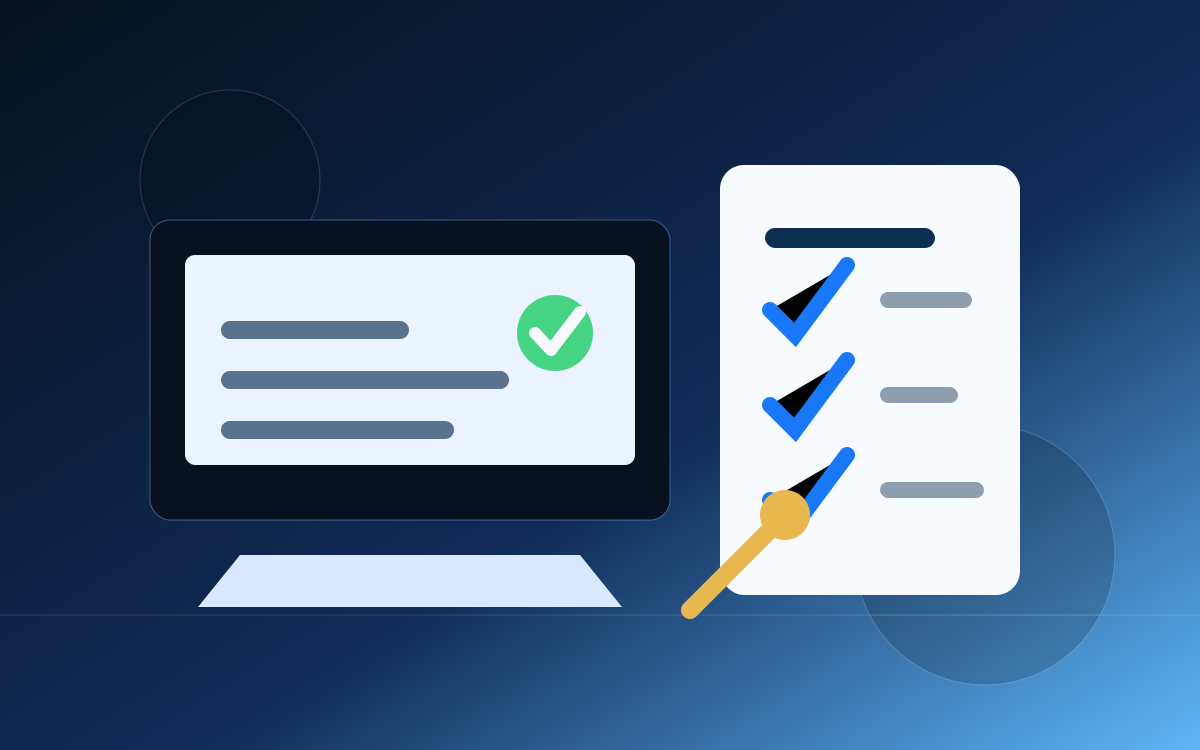
- Look at the everyday interruptions first, not just the big projects
- Make Microsoft 365 or Google Workspace, passwords, and employee access safer
- Confirm backups can actually be restored before an emergency
- Turn recurring computer problems into a clearer support plan
The small tech problems are usually the warning signs
A lot of IT trouble starts quietly. A computer takes ten minutes to become usable. A shared file disappears. A user gets locked out of email right before a meeting. The Wi-Fi works in one corner of the office but not another. Someone keeps restarting the same printer and hoping it behaves. None of these problems may feel large enough to call a project, but together they steal time from the day.
For a Brighton business, this is often where the managed IT conversation should begin. Before talking about new tools, subscriptions, or major upgrades, it helps to write down what interrupts the team most often. Which devices are unreliable? Which software causes the most frustration? Which problems keep coming back after someone temporarily fixes them? A simple list like that can show where support is needed first.
This also helps avoid the trap of buying technology before the real problem is understood. If the office is dealing with slow computers, poor documentation, messy user accounts, weak backups, and no clear support process, adding another platform will not fix the foundation. A better first step is to make the everyday environment easier to support and easier for employees to use.
Give employees one clear place to ask for help
When employees are not sure who to contact, small issues bounce around the office. One person texts the owner, another asks a coworker, another calls a software vendor, and another ignores the issue until it becomes urgent. That is how simple support problems turn into long interruptions.
A managed IT setup should give the team a clear way to ask for help and should track what keeps happening. The goal is not just to close tickets. The goal is to notice patterns. If several people report slow machines, there may be an aging-device problem. If password resets are constant, the sign-in process may need cleanup. If a vendor keeps blaming the network, the network should be documented and tested so the answer is not guesswork.
For small businesses around Brighton, this kind of structure can make technology feel less chaotic. Employees know where to go. Owners can see what is being handled. Recurring issues are easier to find. That is usually more valuable than a stack of technical reports no one has time to read.
Clean up Microsoft 365 or Google Workspace before it becomes a security problem
Microsoft 365 or Google Workspace is one of the most important systems many businesses use, which also makes it one of the first places to review. Email, documents, calendars, Teams, OneDrive, SharePoint, and user accounts all tie back to it. If access is messy, security is messy too.
A practical review should confirm that multifactor authentication is turned on, former employees are removed, admin accounts are limited, mailbox forwarding rules are checked, and sign-in alerts are watched. It should also look at who has access to shared folders and whether sensitive files are sitting in places they should not be.
This does not need to be made scary. The point is simple: if a password is stolen, the account should not be easy to take over. If someone leaves the company, their access should not linger. If a suspicious sign-in happens, someone should notice. For many small businesses, improving these basics is one of the most important cybersecurity steps they can take.
Backups should be proven, not assumed
Backups are one of the areas where businesses often feel protected until the day they need to recover something. A cloud service, an external drive, a server backup, or a software vendor may all sound like protection, but the real question is whether the business can restore the right data quickly enough to keep working.
A backup review should answer a few plain questions. What is being backed up? How often does it run? Where is the backup stored? Who receives alerts if it fails? Has anyone tested a restore recently? How long would it take to recover the files, email, database, or workstation that matters most?
This matters because ransomware, accidental deletion, failed hardware, and vendor mistakes do not wait until the office has time to figure out recovery. If the answer is unclear, the next step should be a test restore. A verified backup is much more useful than a backup dashboard that looks fine but has never been challenged.
Business computer support is part of the bigger IT picture
Some companies separate computer repair from managed IT, but in real life they overlap. A failing laptop, a damaged profile, a slow workstation, a bad hard drive, or a virus concern can affect the whole workday. If the device is used for business, it should be looked at in the context of the business environment.
That means checking more than the single machine. Is the device encrypted? Is it patched? Is endpoint protection working? Are important files stored only on that computer? Does the user have the correct Microsoft 365 or Google Workspace access? Is there a plan if the device fails completely? Those questions help turn a one-time fix into better long-term support.
For Brighton businesses, the goal is not to make every computer perfect. The goal is to keep people productive and reduce surprises. Sometimes that means repairing a device. Sometimes it means replacing it. Sometimes it means standardizing what the company buys so support is easier next time.
Cybersecurity works best when it is built into normal IT
Cybersecurity should not be treated as a separate project that only happens after everything else. It is part of daily IT. Patching, endpoint protection, email filtering, DNS filtering, password policy, account access, backup testing, and employee offboarding are all normal IT tasks with security impact.
A helpful first step is to rank the risks instead of trying to do everything at once. If MFA is missing, start there. If backups have never been tested, test them. If former employees still have access, clean that up. If every computer is different and no one knows what protection is installed, document the devices. These are not flashy steps, but they reduce real risk.
This is also where a local technology partner can help. Many small businesses do not need a complicated security program on day one. They need someone to look at the environment, explain what matters most, and help fix the gaps in an order that makes sense.
Stabilize the basics before adding more tools
New software will not solve an environment that is already hard to support. If files are scattered, accounts are confusing, devices are inconsistent, and no one has a clear support process, adding another tool usually creates another place for work to get stuck.
A better approach is to clean up the daily foundation first. Document the devices people rely on. Standardize the most common settings. Make sure business files are stored in the right place. Confirm who owns each vendor account. Review what happens when someone starts or leaves the company.
For a Brighton business, that kind of cleanup can make future technology decisions easier. Once the basics are stable, it is much clearer which tools are actually helping and which ones are just adding noise.
A Brighton IT tune-up that starts with the daily headaches
If your company is trying to decide where to start, begin with a short IT tune-up. List the top five problems employees complain about. Review Microsoft 365 or Google Workspace access and MFA. Confirm whether backups can be restored. Identify the oldest or most unreliable devices. Look at whether former employee access is fully removed. Then decide which issue creates the most risk or the most wasted time.
That kind of review gives the business a practical roadmap. It may point to managed IT support, cybersecurity cleanup, business computer support, backup and disaster recovery work, or website improvements. The important part is that the next move is based on what is actually happening in the business, not on a generic checklist.
RightCyber Solutions works with Colorado businesses that want technology to feel less frustrating and more dependable. If your team is dealing with recurring IT issues, uncertain backups, security concerns, or devices that keep slowing people down, the starting point can be a simple conversation about what is going on and what should be fixed first.
Brighton 15-minute IT interruption check
A short interruption check starts with the areas that most often slow a Brighton team down: recent sign-ins, MFA status, old users, mailbox forwarding rules, backup restore proof, device health, Wi-Fi complaints, and who owns each recurring support issue.
RightCyber can review one high-risk area first instead of turning the conversation into a giant project. If you already have an IT provider, this can work as a second opinion on backups, Microsoft 365 or Google Workspace, account cleanup, or cybersecurity readiness.
FAQ
What should a Brighton business include in an IT checkup?
A practical IT checkup should review recurring support issues, Microsoft 365 or Google Workspace access, backups, device health, employee onboarding and offboarding, MFA, and basic cybersecurity controls.
What should a Brighton business fix first in IT?
Start with the issues that interrupt work most often: slow devices, support response, Microsoft 365 or Google Workspace access, backups, employee offboarding, and basic cybersecurity controls like MFA and endpoint protection.
Do small businesses in Brighton need managed IT?
If technology problems are slowing employees down, backups are uncertain, security settings are unclear, or the owner is the default IT person, managed IT can reduce interruptions and help the business plan ahead.
Can RightCyber help with cybersecurity too?
Yes. RightCyber supports managed IT, cybersecurity, backup and recovery, business computer support and websites for Colorado businesses.